
Nobody tells you that the bassinet has an expiry date. You set it up beside your bed, you get used to reaching across at 3am without properly waking up, and then one night your baby does a small, casual barrel-roll and the whole arrangement is over. This is the guide to seeing that moment coming — and to making the cot feel like an upgrade rather than an eviction.
The short answer: when they start to roll
Red Nose is unambiguous about this. A bassinet is a short-term product, and your baby should move to a cot when they show signs of being able to roll — usually around four months, though it depends entirely on your child. Some babies get there at three months. Some hold out until five. The calendar is a guide; your baby is the actual instruction manual.
There are three other signals worth watching for, and any one of them is enough:
- Pushing up on hands and knees. Every bassinet sold in Australia now has to carry a warning that use stops at this point. It is the clearest line in the sand there is.
- The weight limit. Check the manufacturer's maximum — it's usually somewhere between 9 and 11 kg, and plenty of babies reach it before they reach the rolling milestone.
- Length. If the top of their head and the soles of their feet are both close to the ends, they've outgrown it regardless of what the scales say.

What changed on 19 January 2026
If you're shopping now, you're shopping under a new set of rules. From 19 January 2026, the ACCC's mandatory standards for infant sleep products apply to bassinets, cradles, co-sleepers, inclined sleepers, household cots and portable folding cots. It's the biggest change to baby sleep safety regulation in Australia in decades, and it came after a review of infant deaths linked to unsafe sleep products between 2001 and 2022.
The parts that matter to you across the counter:
- Bassinets must be at least 250 mm deep from the sleep surface to the top edge, keep any slat gaps between 50 mm and 65 mm, and carry that hands-and-knees warning.
- Household cots must comply with AS/NZS 2172:2013 (or an accepted international equivalent) — covering entrapment, stability, strength and dimensions.
- Portable folding cots sit under AS/NZS 2195:2010, a separate standard with its own requirements. A travel cot is not a household cot, and the two aren't interchangeable.
- Products marketed for sleep that aren't sleep products — bouncers, rockers, swings, hammocks — are now captured too, if they're sold as suitable for sleeping. Which is a polite regulatory way of saying: babies shouldn't be left to sleep in them.
Anything sold new in Australia has to meet these rules, and our Safety & Testing page sets out what each of our sleep products is tested against. If you're inheriting a bassinet or cot from a friend or a marketplace listing, this is the one place we'd ask you not to save money. A 2019 bassinet doesn't become compliant because it looks fine.
A bassinet is a four-month product. A cot is a four-year one. Buy the bassinet for convenience and the cot for the long haul, and you'll spend the right amount on each.
Making the move without losing a week of sleep
The transition is less about the furniture and more about the change in scenery. A few things that reliably help:
- Start with day naps. A week of daytime sleeps in the cot before you attempt a night makes the room familiar while the stakes are low.
- Keep one constant. Same sleeping bag, same wind-down, same words. If everything changes at once, the change is what they notice.
- Stop swaddling at the same time. Once rolling starts, arms come out. Do it in the same week as the move rather than dragging your baby through two separate adjustments.
- Set the base high, for now. Most cots have an adjustable base — start at the top height while they're still small, and drop it the moment they can push up on their hands. Not the week after.
- Expect three rough nights. Then it's usually done. If you're still fighting it at a fortnight, it's worth a chat with your child health nurse rather than more strategy.

What we'd put in each room
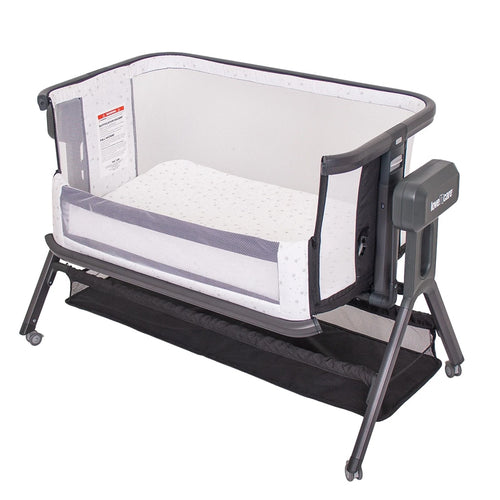
For the first four months, beside your bed. Red Nose recommends room-sharing for the first six to twelve months, so the bassinet's job is to sit within arm's reach. The Glide Sleeper is a 3-in-1 — bedside co-sleeper, standalone crib and travel cot — with a timed glide that rocks bub back down without you getting up. The Traversina Sleeper straps to the bed frame, adjusts for height on each side independently, and tilts slightly for a refluxy baby. If you'd rather something simple and timber, the Wieg Crib in warm ash does one job well. All three live in Bedside Sleepers.
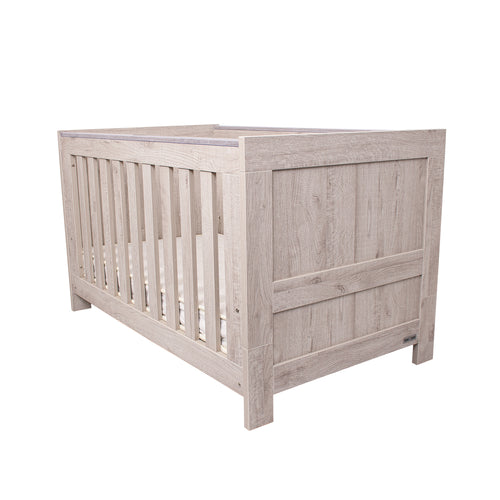
From four months, the cot. Look for an adjustable base and, ideally, a conversion to a junior bed — that turns one purchase into three or four years of use. The Bordeaux Cot converts, has two base positions and teething rails, and takes a 131 × 76 cm mattress. The Noor, Iris and Fjord cots sit alongside it in Cots & Cot-beds.
For grandparents and holidays. A folding cot is its own category with its own standard — the Sleep N Go Travel Cot and the Playland Travel Cot both fold to a bag and set up without tools.
One last thing worth saying plainly: the cot doesn't need to be in its own room for this transition. Moving out of the bassinet and moving out of your bedroom are two separate decisions, and there's no rule that says they have to happen in the same month. Do the one your baby is ready for, and leave the other for later.
Next in the sequence is the mattress, which matters more than the cot does — we've written that one up in the cot mattress guide.