
Most pram advice is about lifestyle — boot space, footpaths, whether you're a beach family or a café family. We've written that one already, and it's the right first question. This is the second one, and almost nobody asks it out loud: is this pram actually safe, and am I using it properly?
The reassuring part is that Australia has a mandatory standard and it does a lot of the work for you. The less reassuring part is that the most common pram injuries have nothing to do with the pram's design and everything to do with the ninety seconds around a kerb, a coffee and a shopping bag. So here's both halves: what to check before you buy, and what to check before you walk out the door.
Before you buy: six things on the pram itself
Prams and strollers sold in Australia have to meet a mandatory standard based on AS/NZS 2088. Newer models will reference AS/NZS 2088:2013 or AS 2088:2022. What that standard requires is a useful shopping checklist in its own right:
- The compliance label. Find it before anything else — usually on the frame near the fold mechanism. No label, no purchase. This is the single most important check on this page, and it takes four seconds.
- A five-point harness. Two shoulders, two hips, one crotch strap. Three-point harnesses don't stop a determined baby standing up. Check you can adjust the shoulder height as they grow.
- A parking brake you can see. The standard requires the brake activation to be red, clearly visible, and positioned out of a restrained child's reach. If you can't spot it at a glance in the shop, you won't find it with one hand on a slope.
- The tether strap. Every pram must be supplied with one — the wrist strap that keeps the pram attached to you if it gets away. Under the standard its loop has to be under 360 mm so it can't become a strangulation hazard. Suppliers must provide it; they don't have to fit it, so check it's in the box and then actually use it.
- A frame that doesn't flex. Push down on the handle with the brake on. A little movement is normal; a wobble that travels through the whole frame is not.
- A fold you can do one-handed. Not a safety requirement, but it becomes one the first time you're folding a pram at the boot with a baby on your hip.

The newborn question: flat matters
For roughly the first six months, a baby needs to travel flat. Their neck control isn't there yet, and a semi-upright seat lets the head fall forward and compress the airway. That gives you three ways to do the newborn stage properly:
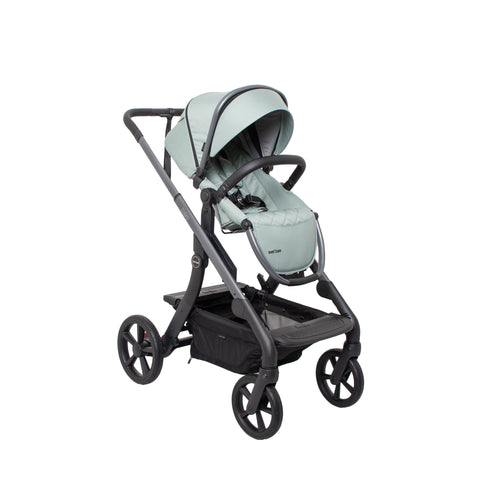
- A bassinet or carry cot on the frame — the flattest option and the most comfortable for long walks. The Neo converts to a bassinet mode, and there are dedicated carry cots for the egg2 and the Phantom, with the full range in Carry Cots.
- A capsule on the frame via an adaptor — convenient for car-to-pram transfers, but capsules are for travel, not for sleeping. Around 30 minutes at a time is the general guidance; a sleeping baby left in a capsule for hours is in the same head-forward position you're trying to avoid. Adaptors live in Car Seat Adaptors, including the Neo Maxi Cosi adaptor and the egg multi adaptors.
- A seat that reclines genuinely flat — not "nearly flat". Lay it back in the shop and look at it side-on.
The compliance label, the red brake and the tether strap. If a pram has all three and you actually use the third one, you've cleared the bar that matters most.
Before every walk: the thirty-second check
This is the half that prevents the injuries that actually happen in Australia each year — and every one of these is about a moment of ordinary distraction, not carelessness.
- Harness on, every time. Including the two-minute trip to the letterbox. Falls from prams overwhelmingly involve an unbuckled child.
- Brake on before you let go. Kerbs, ramps, train platforms, the slight slope in a car park you never noticed. On before your hand leaves the handle, not after.
- Tether strap on your wrist whenever there's a road, a slope or a platform involved.
- Shopping in the basket, not on the handles. Bags hung off the handle are the classic tipping cause — the pram goes over backwards, and it happens instantly. Use the basket underneath: the Neo shopping basket exists for exactly this.
- Fingers clear of the fold. Both yours and any helpful toddler's. Fold with the baby out of the pram.
- Never leave a sleeping baby unattended in a pram, and don't use the pram as a substitute for a cot at home.

Two things about Australian conditions
Heat. Don't drape a muslin or blanket over the canopy to block the sun. It cuts airflow and can turn the inside of a pram into a genuine hot box in minutes — the temperature climbs far faster than most people expect. Use the pram's own extendable canopy, aim for one with a UPF rating and a mesh window, walk in the shade, and check on your baby often. In real heat, don't go.
Rain. A fitted raincover is safer than a towel or a plastic bag over the hood, because it's designed with ventilation. Take it off the moment you're inside — a raincover on a stationary pram indoors traps heat quickly. Ours are in Adaptors & Accessories, including the Phantom raincover and the Phantom footmuff for the other extreme.
Where to start looking
If you want one frame to cover newborn through toddler — and a possible second child — a travel system is the honest value play. The Neo Travel System runs bassinet, seat, duo and wagon on one chassis; the egg2 system is the compact-fold option; the Phantom Collection is the lightweight everyday pram with its own accessory set. Everything else is in Strollers & Prams.
And if you haven't done the lifestyle question yet, do that one first — How to choose a pram that lasts narrows the market down to about three prams in ten minutes. This page is what to do once you've got those three in front of you.