Babies do not give notice. One week you're putting your baby down on a playmat and finding them exactly where you left them; the next, you turn around to get a cup of tea and they've made it to the bookshelf. Most babies start moving somewhere between six and twelve months, and a good number skip crawling entirely and go straight to pulling up on the furniture — which is a different, and frankly more alarming, set of problems.
The rule of thumb is simple: baby-proof a month before you think you need to. Doing it after the first surprise crawl means doing it in a panic, with a mobile baby in the room. Here's the sweep, room by room, in the order that actually matters.
First: anchor everything tall
If you do only one thing from this article, do this one. Toppling furniture causes serious injuries and deaths in Australian homes every year, and it's almost entirely preventable with a $10 bracket and twenty minutes. A toddler pulling out the bottom drawer of a chest to use as a step is all it takes.
Australia now has a mandatory information standard for toppling furniture, in force since 4 May 2025, which requires suppliers to warn about tip-over risk at the point of sale, on the product and in the instructions — it covers chests of drawers, wardrobes, bookcases and display cabinets over 686 mm tall, plus all entertainment units. The warning is a prompt, not a fix. The fix is the strap.
- Anchor every chest, tallboy, wardrobe, bookcase and TV unit to a wall stud — not just plasterboard.
- Anchor the ones in your room and the living room too, not only the nursery. Babies go where you go.
- Mount TVs to the wall, or anchor the stand. A tipping TV is heavier and higher than anything else in the room.
- Keep heavy things low, and don't put anything tempting on top of a tall unit — the remote, a toy, a phone charger. Interest is the whole mechanism.
- Re-check the fixings after you move house or rearrange. This is the moment they get left behind.
Every chest and wardrobe we sell — the Bordeaux Chest, Tallboy and Wardrobe among them — should be anchored as part of assembly rather than "later" — the step is in our Assembly Guides, and if you're fixing into plasterboard, use a stud finder and proper wall anchors.
Gates: the right gate in the right place
Two kinds of gate, and the difference genuinely matters:
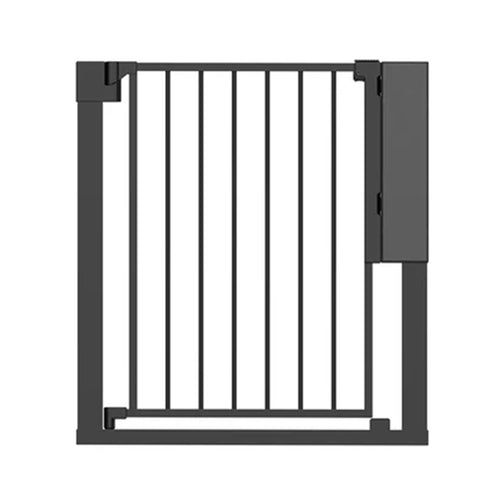
- Pressure-mounted gates brace against the door frame with no drilling. They're perfect for doorways, hallways and the bottom of stairs, and they're the ones you can move around or take to grandparents'.
- Hardware-mounted gates screw into the frame. This is the only type to use at the top of a staircase, where a gate that gets knocked out of position has the worst possible consequence. Don't compromise on this one.
Our Safety Gate is pressure-mounted: solid metal, opens both ways, self-closing, one-handed operation, and fits openings from 75 to 82 cm. Wider doorway? Add an extension in 20, 30 or 45 cm. On soft or uneven surfaces, the wall cups spread the pressure and stop the gate marking the frame, and the Y-spindle handles a stair-post fixing. The full range is in Gates & Safety.

Get down on your hands and knees and crawl the house. It's undignified, it takes ten minutes, and you'll find things standing up would never have shown you.
The room-by-room sweep
Living room. Corner guards on the coffee table. Cords for blinds and curtains tied up high and out of reach — a looped cord is a strangulation risk, and it's one of the few hazards in this list that can be fatal in a matter of minutes. Power points covered. Loose rugs on non-slip backing. Fireplace or heater gated off.
Kitchen. Latches on the cupboards containing anything chemical, and move them up high anyway — a latch is a delay, not a lock. Saucepan handles turned inward. Kettle and appliance cords pushed back from the bench edge. A closed dishwasher with the detergent still in it is a common one people miss.
Bathroom. Never leave a baby in the bath unattended for any length of time, for any reason — not to answer the door, not to grab a towel. Empty the tub immediately after. Toilet lid closed or latched, medicines in a locked cupboard, and the hot water thermostat turned down to 50°C at the tap.
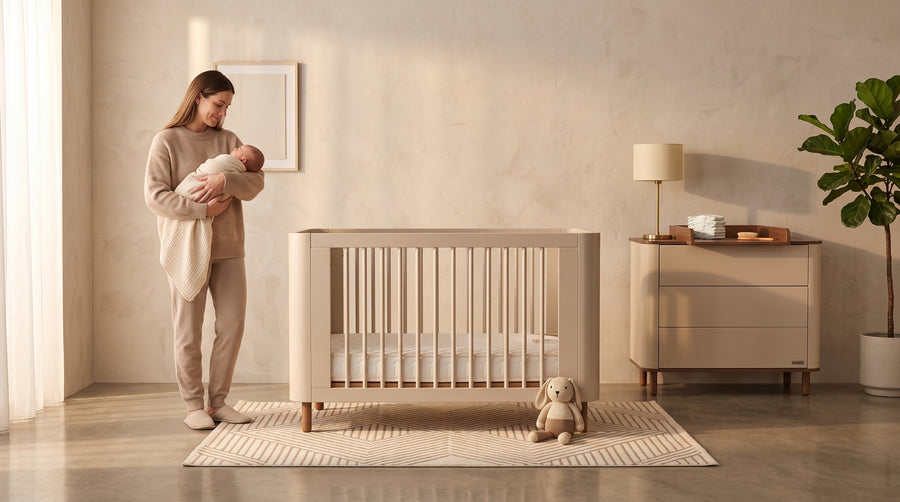
Nursery. The cot base drops to its lowest setting the moment your baby can pull up — this catches people out because it needs to happen before the first attempt, not after it. Nothing hanging on the cot rails. Nothing climbable placed next to the cot. Nappy cream, sanitiser and wipes out of arm's reach of the change table.
Everywhere. Button batteries, which deserve their own line. They're in remotes, scales, car key fobs, musical cards and cheap toys, and a swallowed one can cause catastrophic internal burns within a couple of hours. Check every battery compartment is screw-secured and store spares locked away. If you suspect a child has swallowed one, call the Poisons Information Centre on 13 11 26 immediately.
Give them somewhere to be
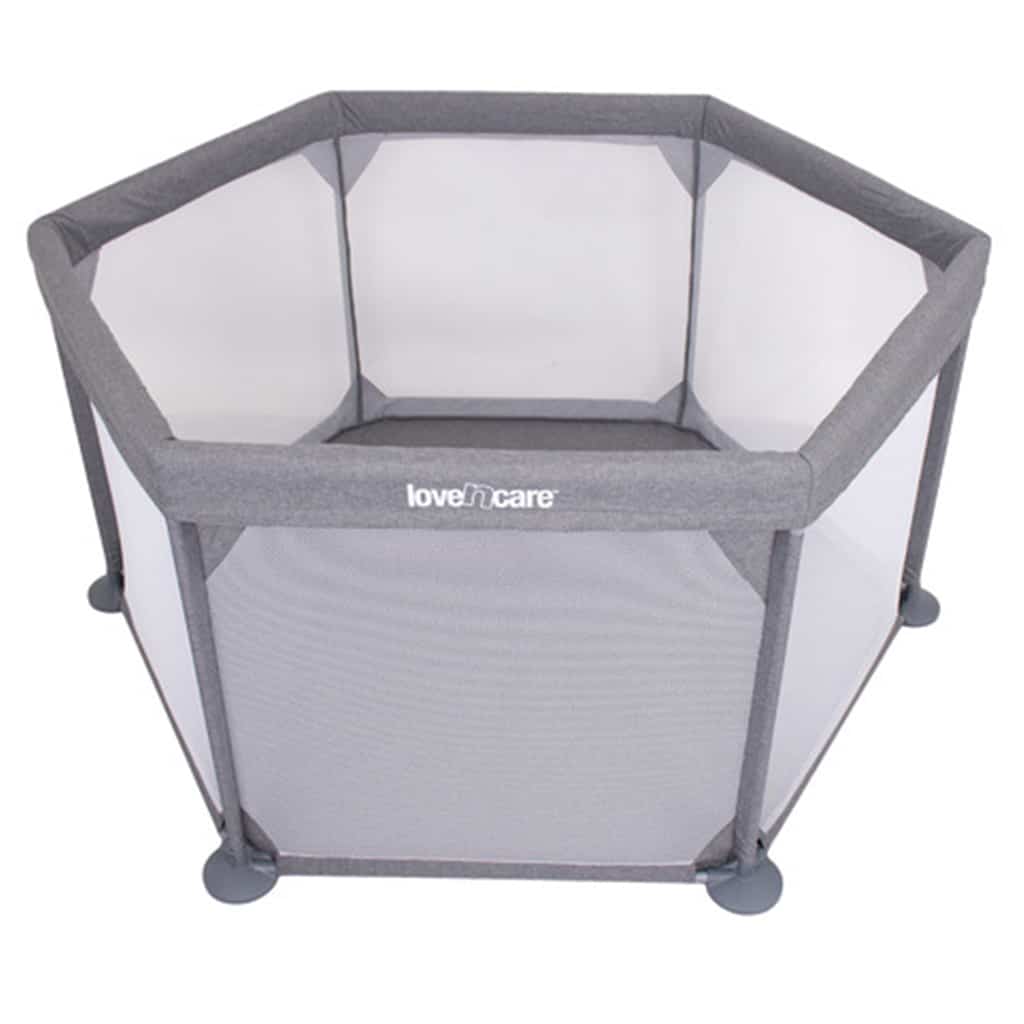
Baby-proofing gets easier if there's one place your baby can be for ten minutes that you don't have to think about. A Play Yard folds flat, sets up without tools and gives you a contained space for a shower or a phone call. Underfoot, a padded playmat softens the pulling-up-and-falling-down phase — the Amusement Park and Cats in Cups mats are double-sided and wipeable, which you will appreciate. Both categories sit in Play & Safety.
The point of all this isn't to shrink-wrap the house. It's to remove the handful of things that can hurt badly, so that the rest of the day can be spent watching your baby figure out how to move — which is one of the genuinely great things to watch — instead of intercepting them.
Doing the nursery from scratch? Start with Setting up the nursery, room by room.