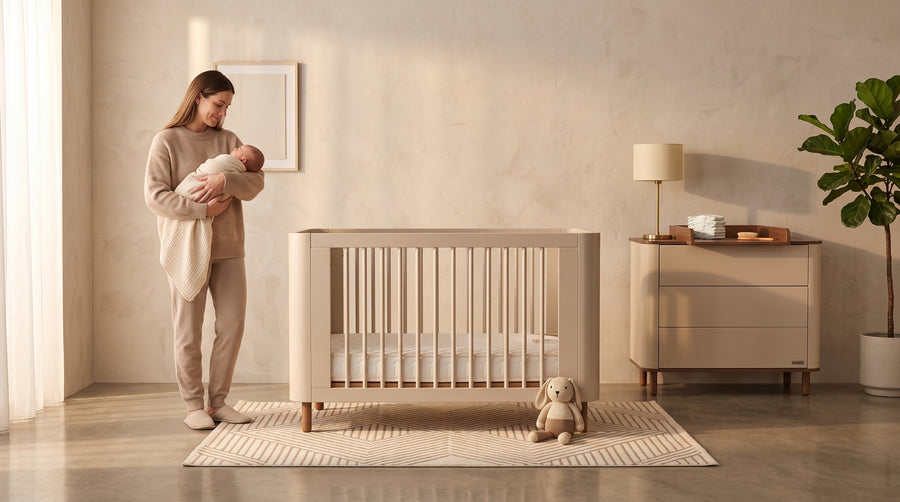

There is a version of the nursery that exists on Pinterest, and there is the version you will actually live in at 2am with a torch on your phone and one sock missing. This guide is about the second one. After four decades of helping Australian families set up for a new baby, we can tell you the honest truth: the room needs about six things done well, and everything else is decoration. Here they are, in the order they matter.
Start with the cot — and the standard on the box
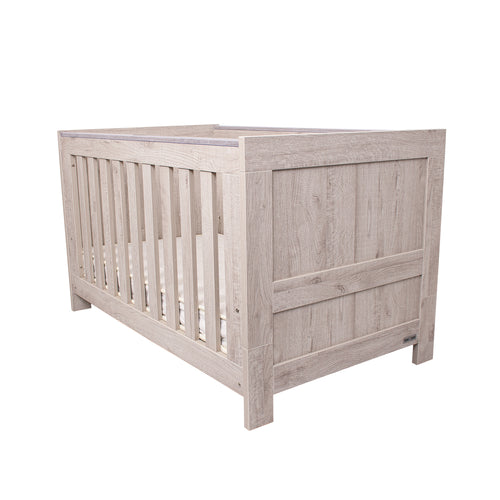
Everything else in the room can be a compromise. The cot can't. In Australia, household cots must meet the mandatory standard AS/NZS 2172, which governs the things you can't judge by eye: bar spacing that can't trap a limb or a head, depth that can't be climbed out of, no footholds, no protrusions that can snag clothing. Any cot sold new here must comply — but if you're inheriting or buying second-hand, check for the certification label before anything else. No label, no cot.

Beyond the standard, think in years, not months. A cot with an adjustable base height saves your back in the newborn stage and drops low once bub learns to pull up — usually around eight or nine months, and always sooner than you expect. If it converts to a toddler bed later, one purchase covers the first three or four years.
The mattress: firm, flat, and exactly the right size
The mattress matters more than almost anything else in the room, and the rules are beautifully simple: firm, flat, and well-fitting. A newborn should never sleep on a soft surface, and the fit matters as much as the firmness — red-nose-safe guidance is a gap of no more than 20 mm between the mattress edge and the cot side, so little limbs can't slip into the space.

Buy the mattress that matches your cot's internal dimensions exactly, add a waterproof protector under the fitted sheet (you will thank yourself, likely within the week), and stop there. No pillows, no doonas, no cot bumpers, no soft toys in the sleep space for the first year. A safe cot is a wonderfully boring cot.
Set the room up for the worst night, not the best photo. A nursery that works at 2am works at every other hour for free.
The feeding chair: buy it for the parent
For the first three months you will spend more waking hours in this chair than anywhere else in the house — some nights, more hours than in your bed. This is the one item where comfort is not a luxury. Look for a deep recline, a glide that's genuinely silent (squeaks at 2am feel personal), and armrests at the right height to support a feeding pillow.

Put it near a small table for the water bottle and the lamp, and choose a warm, dim bulb. Bright overhead light at 2am wakes everyone fully — the baby, you, and any hope of getting back to sleep inside the hour.
The change station: one reach, one hand
You'll do somewhere north of 2,000 nappy changes in the first year, so the geometry matters. Whether it's a dedicated change table or a pad on top of a dresser, the rule is the same: everything within one arm's reach, because the other hand stays on the baby. Always. Babies pick their moment to learn to roll, and it is usually the moment you turn around for a wipe.

- A contoured change pad with raised sides — wipeable beats washable at 3am
- Nappies and wipes stocked in an open basket, not a drawer you need two hands for
- A lidded bin within reach — non-negotiable, for reasons you will discover
- Two changes of clothes stationed right there, because the spectacular ones happen mid-change
What can wait
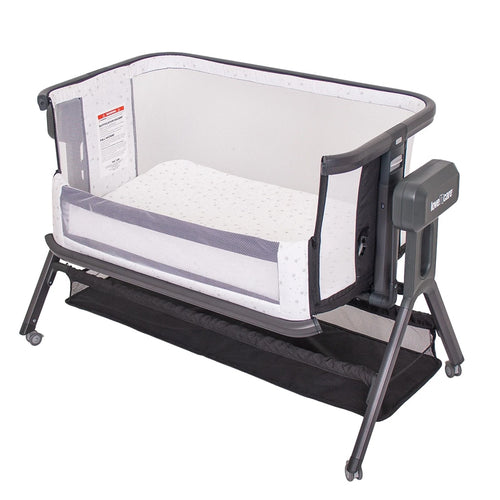
The nursery doesn't need to be finished for the baby to come home — for the first six months or so, the safest place for bub to sleep is a bassinet or bedside sleeper in your room anyway. So the toy storage can wait. The bookshelf can wait. The high chair is half a year away, and the wardrobe of size-1 outfits will mostly be outgrown with the tags still on. Spend properly on the cot, the mattress and the chair; let the rest arrive as real life asks for it.
One last thing: the room doesn't need to be perfect, and neither do you. A safe place to sleep, a comfortable place to feed, a change station that works one-handed — that's a finished nursery. Everything else is just very lovely decoration.